According to the Pew Research Center, women aged 25 to 34 are more likely than men in the same age group to hold a bachelor’s degree. This gender gap in degree completion is evident across all major racial and ethnic groups, though the extent of the gap varies significantly.
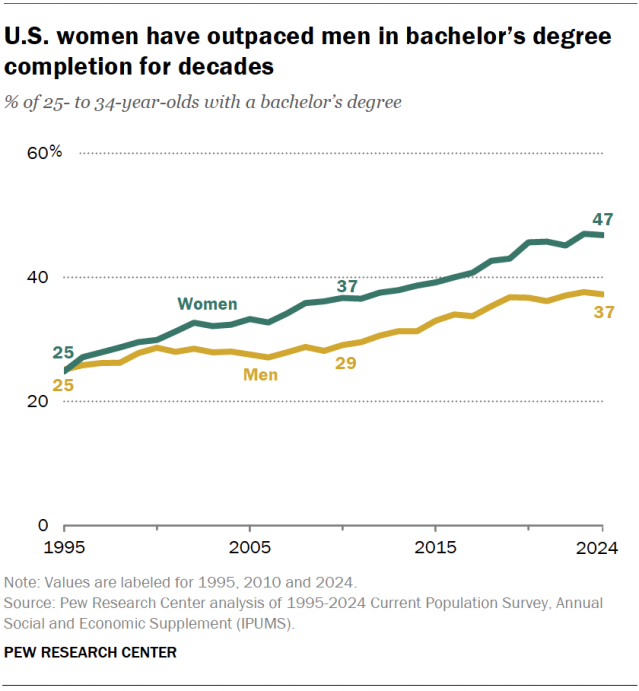
In 1995, young men and women were equally likely to hold a bachelor’s degree (25% each). Since then, there has been a growing gap between men and women in college completion.
Today, 47% of U.S. women ages 25 to 34 have a bachelor’s degree, compared with 37% of men.
The share of young women with a bachelor’s degree has increased by 22 percentage points since 1995, from 25% to 47%. Over the same period, men have seen a smaller increase (12 points, from 25% to 37%).
How we did this
A 2021 Pew Research Center survey asked Americans without a bachelor’s degree why they chose not to seek one – and found some gender differences in the responses. For example, men without a bachelor’s degree were more likely than women to say they just didn’t want to get one. In turn, women without a bachelor’s degree were more likely than men to say they couldn’t afford a four-year degree.
Gender gaps in college completion by race and ethnicity
White, Black, Hispanic and Asian women between the ages of 25 and 34 are all more likely than their male counterparts to have a bachelor’s degree. But some groups have made more gains over time than others.
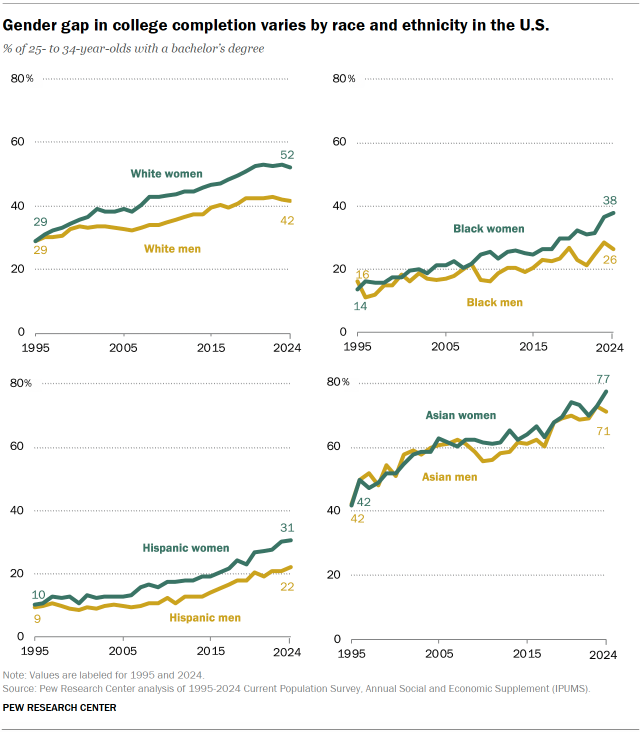
White, Black and Hispanic women have outpaced men in college completion in recent decades. For example, in 1995, young White women and men were equally likely to have a bachelor’s degree (29% each). The gap has increased to 10 points today (52% of White women vs. 42% of White men).
Similarly, in 1995, young Black women and men were about equally likely to have a bachelor’s degree (14% vs. 16%). Today, Black women are 12 points more likely than Black men to have one (38% of Black women vs. 26% of Black men).
There is also a growing gender gap between Hispanic men and women in college completion. In 1995, similar shares of Hispanic women and men had a bachelor’s degree (10% vs. 9%), but today the gap between groups is 9 points (31% vs. 22%).
The pattern is different for Asian adults, with women and men making comparable gains over the last few decades. In 1995, 42% of young Asian women and men had a bachelor’s degree. Today, 77% of young Asian women have one, as do 71% of young Asian men.
This research was earlier published by the Pew Research Center.